Red Eye in Clinical Practice: When You MUST Consult an Ophthalmologist
Introduction
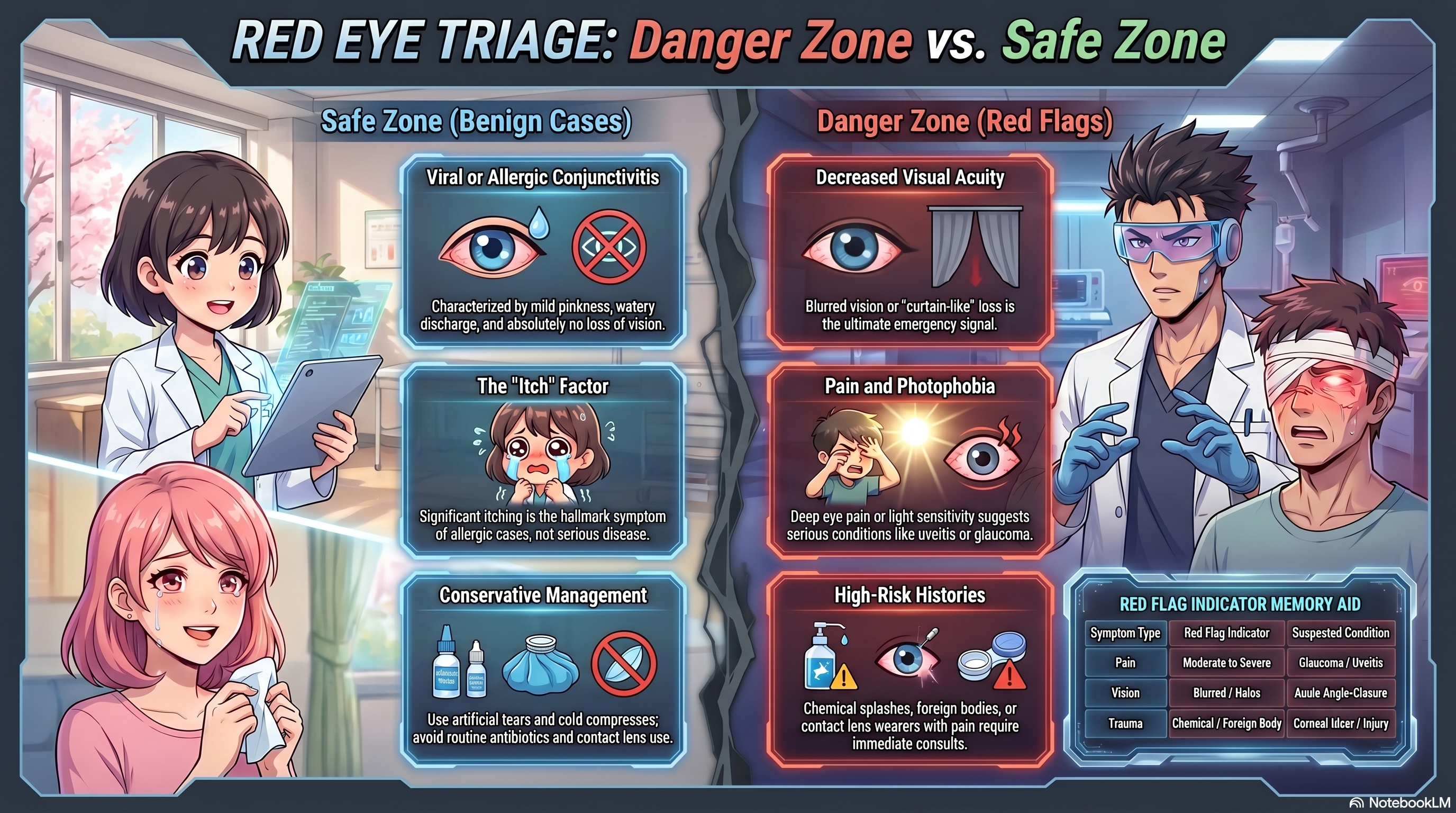
Red eye is one of the most common presentations in outpatient and emergency settings. Most cases are benign (e.g., conjunctivitis), but missing a vision-threatening condition can lead to permanent blindness.
As a new doctor, your job is not to diagnose everything — your job is to recognize danger early and refer appropriately.
🧠 Step 1: Think Simple First
Ask yourself:
👉 “Is this just conjunctivitis, or could this destroy vision?”
Most benign cases:
- Mild pink/red eye
- Watery discharge
- No significant pain
- No visual loss
👉 These are usually viral or allergic conjunctivitis
⚠️ Step 2: RED FLAGS = CONSULT NOW
If ANY of the following are present →👉 Immediate ophthalmology consult (same day / emergency)
🔴 Vision-related
- Blurred vision (true visual acuity reduction)
- Patient says: “I cannot see clearly like before”
🔴 Pain-related
- Moderate to severe eye pain
- Not just irritation or itch
🔴 Light sensitivity
- Photophobia→ Think uveitis / keratitis
🔴 Dangerous associated symptoms
- Headache + nausea + vomiting→ Think acute angle-closure glaucoma
- Seeing halos / rainbow around lights
🔴 Trauma / Exposure
- Chemical splash
- Foreign body
- Eye injury
🔴 Contact lens wearer
- Red eye + pain→ High risk for corneal ulcer (EMERGENCY)
🔴 Cornea abnormal
- Corneal opacity
- Suspected ulcer
🔴 Retinal warning signs
- Flashes
- Floaters
- Curtain-like vision loss→ Retinal detachment
⚡ Golden Rule for New Doctors
👉 “Red eye + decreased vision = NOT conjunctivitis until proven otherwise.”
🟢 Step 3: Likely Benign Cases (NO Red Flags)
These can be managed conservatively:
✅ Allergic conjunctivitis
- Itchy (key symptom)
- Watery discharge
- Mild redness
- Eyelid swelling
✅ Viral conjunctivitis
- Watery eye
- Mild irritation
- Starts unilateral → bilateral
🩺 Basic Management (Non-emergency)
- Artificial tears
- Cold compress
- Avoid rubbing eyes
- Stop contact lenses
- Hygiene (prevent spread in viral)
❌ No routine antibiotics unless bacterial infection suspected
🎯 Clinical Pearl (High-Yield Exam Point)
Watery eye ≠ mild disease alwaysBUTBlurred vision = RED FLAG ALWAYS
🧪 What You MUST Always Check
Even in busy OPD:
- ✅ Visual acuity (VERY IMPORTANT)
- ✅ Pain level
- ✅ Photophobia
- ✅ Contact lens history
📌 Real-Life Decision Example
Case:
- Pink eye
- Watery
- Mild swelling
- No pain
- Vision normal
👉 Manage as conjunctivitis → NO urgent consult
Case:
- Red eye
- Watery
- “Vision slightly blurred.”
👉 ❗ STOP👉 This is NOT simple conjunctivitis👉 Consult ophthalmology
🧠 Final Takeaway
You don’t need to be an ophthalmologist.
But you MUST know:
👉 Who is safe👉 Who is dangerous
🚨 One-Line Memory Trick
“PAIN + PHOTOPHOBIA + POOR VISION = REFER IMMEDIATELY”