Impacted Cerumen (Earwax Blockage): Clinical Management and Safe Removal Guide
Introduction
Impacted cerumen is one of the most common and easily treatable conditions encountered in outpatient practice. Despite its simplicity, improper management can lead to complications such as ear injury or infection. This guide provides a clear, guideline-based approach suitable for both clinical practice and medical education.
👂 What is Impacted Cerumen?
Cerumen (earwax) is a natural substance produced by glands in the ear canal. It serves to:
- Protect the ear from dust and bacteria
- Lubricate the ear canal
However, when it accumulates excessively, it can cause:
- Hearing loss
- Ear fullness
- Tinnitus
- Occasionally dizziness
⚠️ When Should You Treat?
According to AAO-HNS (American Academy of Otolaryngology) guidelines:
✅ Treat if:
- Symptomatic (hearing loss, discomfort, blockage)
- Obstructing ear examination (e.g., cannot see the tympanic membrane)
❌ Do NOT treat routinely if asymptomatic
🏥 Management Setting
Most cases are safely managed in the Outpatient Department (OPD).
💊 Step-by-Step Management
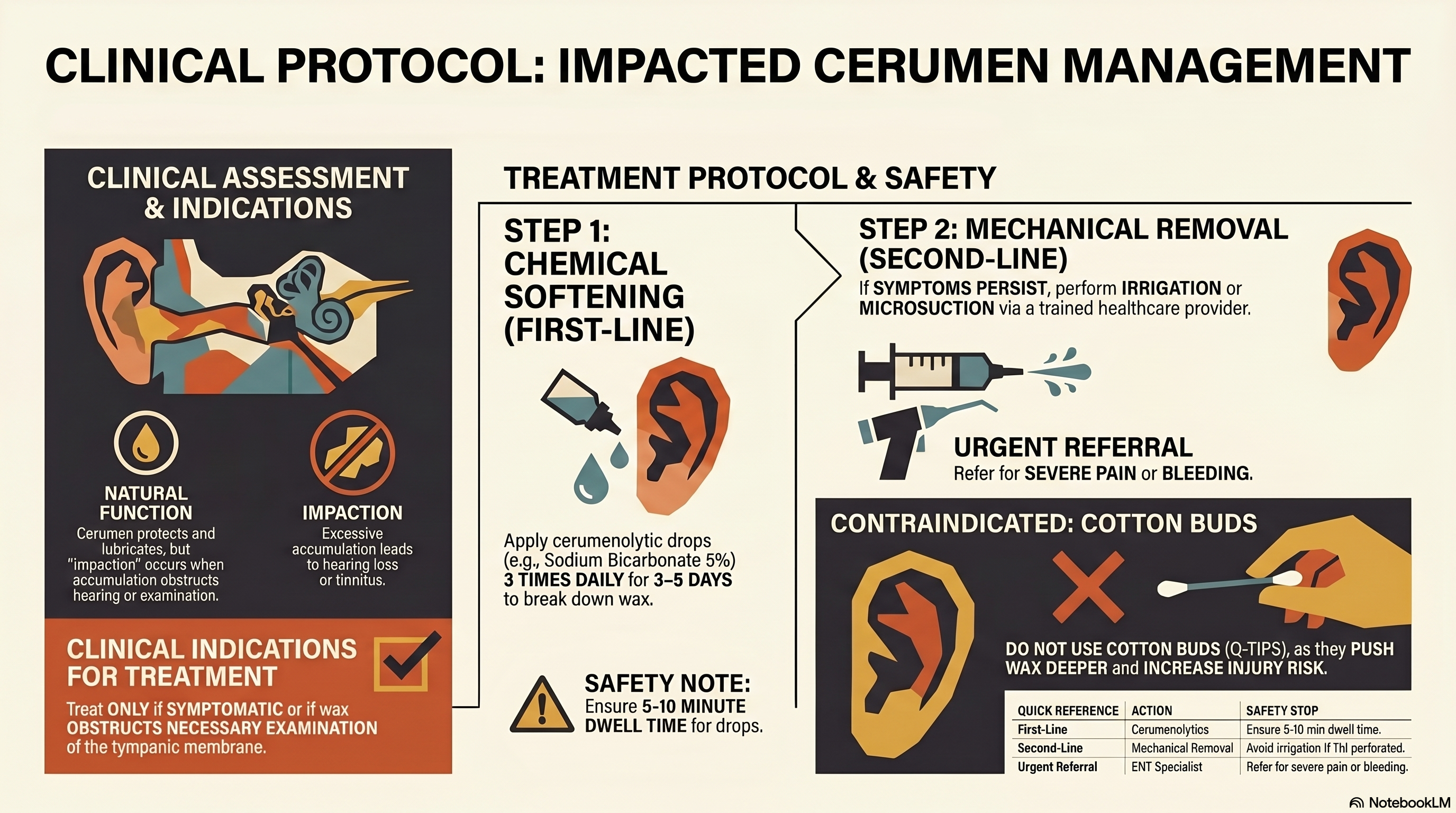
1. First-line: Cerumenolytic Ear Drops
The goal is to soften the wax before removal.
✅ Sodium Bicarbonate 5% (Common in Thailand)
- Dose: 2–3 drops, 3×/day, topical ear, for 3–5 days
- Mechanism: Alkalinizes and breaks down wax
✅ Glycerin Ear Drops
- Dose: 2–3 drops, 3×/day, topical ear, for 3–5 days
- Mechanism: Softens wax (emollient effect)
⚠️ Hydrogen Peroxide 3%
- Dose: 2–3 drops, 2–3×/day, for 3–5 days
- May dilute 1:1 with clean water to reduce irritation
- Mechanism: Releases oxygen bubbles → helps dislodge wax
❗ Use with caution:
- Can cause irritation or vertigo
- Avoid if eardrum is perforated
🛑 How to Use Ear Drops Properly
- Lie on your side (affected ear up)
- Instill drops into the ear
- Stay in position for 5–10 minutes
- Do NOT rinse immediately
- Let excess fluid drain naturally
👉 This step is crucial for effectiveness
2. Second-line: Mechanical Removal
If symptoms persist after 3–5 days:
Options:
- Ear irrigation (warm saline or water)
- Microsuction
- Manual removal with curette
📌 Should be performed by trained healthcare providers
❌ What NOT to Do
- Do NOT use cotton buds (Q-tips) → pushes wax deeper
- Do NOT irrigate if:
- Tympanic membrane perforation
- Active infection
- History of ear surgery
🚨 When to Refer
Refer to ENT specialist if:
- Severe pain or bleeding
- Recurrent impaction
- Suspected perforation
- Failed removal attempts
📚 Clinical Pearls (High-Yield for Exams)
- First-line in Thailand → Sodium bicarbonate ear drops
- Always check for contraindications before irrigation
- Ear drops must be left in place for 5–10 minutes
- Cotton buds = ❌ contraindicated
Summary
| Step | Management |
| First-line | Cerumenolytics (NaHCO₃, glycerin) |
| Second-line | Irrigation / suction |
| Avoid | Cotton buds, unsafe irrigation |
| Refer | Complicated cases |